Smooth DA Process
Avoid costly council rejections and delays by submitting the right report the first time.
Formal, council-compliant tree reports for Development Applications, risk assessments, and tree removal.
Consulting services for Katoomba and the entire Blue Mountains LGA.
When submitting a Development Application or requesting a difficult removal, an Arborist Report Katoomba council planners will actually accept is essential. Because the Blue Mountains sits in an environmentally sensitive area, BMCC strictly enforces Part C5 of the DCP and AS4970. We provide the expert documentation required.
Whether you are building into the Katoomba escarpment or trying to remove a risky Blue Mountains Ash, our reports address the specific ecological and slope overlays council planners look for.
Avoid costly council rejections and delays by submitting the right report the first time.
Solidify your legal standing in neighbour disputes regarding overhanging or dangerous trees.
Know exactly what needs to be done to protect your retained trees during construction.
We discuss your project goals, whether it's a DA, an extension, or a hazard assessment.
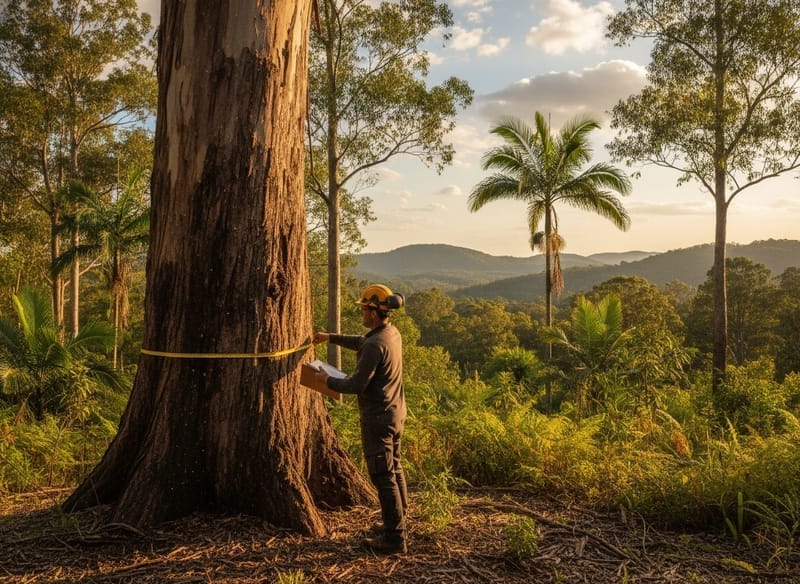
Our AQF5 arborist conducts a thorough on-site evaluation of the trees and soil.
We calculate Structural Root Zones (SRZ) and Tree Protection Zones (TPZ) to AS4970.
You receive a comprehensive, high-quality PDF ready for submission to the NSW Planning Portal.
Navigating tree management and development on the steep, heavily vegetated blocks of the Upper Mountains requires expert guidance. Whether you are clearing an Asset Protection Zone, planning a new build, or managing a declining Sydney Peppermint overhanging your roof, obtaining a professional Arborist Report Katoomba is the crucial first step.
Our team at Blue Mountains Arborist provides comprehensive, AQF Level 5 consulting reports tailored to the unique environmental and regulatory demands of our region. From Katoomba to Blackheath and Leura, properties here sit right in the bushfire prone zone with mature eucalypt canopies directly overhead.
We write the detailed, compliant documentation that Blue Mountains City Council demands, ensuring your DA submissions, hazard reductions, and tree disputes are handled with locally backed arboricultural science. We handle the paperwork so you can move forward with certainty.
Dealing with tree regulations in our region is notoriously complex. Relying on an under-qualified tree lopper or attempting to justify tree removal to council yourself is a fast track to rejected applications, heavy fines, and costly project delays. Blue Mountains City Council enforces a strict Approval to Manage Trees permit regime under Part C5 of the DCP 2015, and they will reject any assessment that is not authored by an AQF Level 5 consulting arborist. We frequently see homeowners and developers hit roadblocks because their initial documentation lacked precise Tree Protection Zones (TPZ) or failed to properly assess Safe Useful Life Expectancy (SULE). When you engage us for an Arborist Report Katoomba, you bypass these frustrating setbacks entirely. Our reports strictly adhere to AS4970 for protecting trees on development sites and AS4373 for pruning standards. We meticulously map out Structural Root Zones, assess defects in old-growth Blue Mountains Ash or Radiata Pines, and provide the scientifically backed evidence council requires. Whether it is proving that a structurally compromised Smooth-barked Apple poses an unacceptable risk to your home, or demonstrating how a new driveway can be built without damaging retained roots, our consulting arborists deliver solutions that protect both your property goals and the local canopy.
As locally based AQF Level 5 consulting arborists, we deliver a full suite of formal documentation required for residential, commercial, and municipal tree management across the Upper Mountains.
Required by Blue Mountains City Council when your proposed building works impact protected vegetation. We conduct a complete tree inventory, species identification, DBH (Diameter at Breast Height) measurement, and SULE rating. We outline exactly which trees can be safely retained and which require removal to facilitate your DA.
Essential for construction sites. We calculate and map out the Tree Protection Zone (TPZ) and Structural Root Zone (SRZ) for trees designated for retention. This plan specifies fencing requirements, root mapping, mulch protection, and supervised work zones to ensure trees survive the build process.
Using Visual Tree Assessment methodology, we evaluate structural defects, disease, and the likelihood of failure in mature trees. This is critical for pre-purchase inspections, insurance purposes, or documenting the hazard posed by a declining Silvertop Ash overhanging a target zone like a house or road.
When you need council approval to remove a protected tree (anything over 4 metres tall or with a 4-metre canopy spread). We document the tree's poor condition, unacceptable risk, or damage to infrastructure, providing the necessary arboricultural justification to secure your permit.
Securing an Arborist Report Katoomba with our team is a streamlined, transparent process designed to keep your project moving efficiently. - Initial Consultation: We discuss your specific goals—whether it is a DA submission, a neighbour dispute, or a safety concern regarding a large Red Bloodwood. We clarify exactly what type of report the local council or your private certifier requires. - Site Inspection and Data Collection: Our AQF Level 5 consulting arborist arrives on-site to conduct a thorough physical assessment. We measure trunk diameters, map canopy spreads, photograph structural defects, take soil notes, and evaluate the tree's health and immediate environment. - Council Overlay Review: We cross-reference our field data with Blue Mountains Local Environmental Plan 2015 overlays. We check for escarpment, landslide risk, terrestrial biodiversity, and bushfire prone land mapping to ensure our recommendations align with local planning instruments. - Drafting and Final Delivery: We compile all findings into a highly detailed, professionally formatted PDF report. This includes site maps, tree protection formulas, photographic evidence, and actionable recommendations. The finalized document is signed off and delivered to you, ready for direct submission to the NSW Planning Portal or your legal representative.
Writing formal tree documentation requires specialized qualifications that go beyond standard tree climbing and lopping. Our reports are authored exclusively by AQF Level 5 (Diploma of Arboriculture) consulting arborists, which is the mandatory qualification accepted by Blue Mountains City Council for formal assessments.
Our business is fully insured with comprehensive Public Liability and Professional Indemnity insurance, protecting you against any professional errors or omissions. We strictly follow the AS4970 standard for tree protection on development sites and AS4373 for all pruning recommendations. When you present our documentation to certifiers, insurers, or council, you do so with the backing of a fully compliant, locally trusted operation.
Katoomba and the surrounding Upper Mountains present unique challenges for arboriculture. We operate on a narrow ridge-top plateau where properties frequently drop away into steep gullies and cliff lines.
Any tree over 4 metres in height or with a 4-metre canopy spread falls under the strict Part C5 Tree and Vegetation Preservation controls. This catches both native Coachwood and planted Monterey Cypress. We also regularly assess hazard trees in relation to the 10/50 Vegetation Clearing Code of Practice, evaluating whether a declining eucalypt sits within your mapped entitlement area or requires a formal permit due to heritage or slope overlays.
Because bushfire is a dominant hazard here, much of our consulting work involves balancing Asset Protection Zone (APZ) clearing requirements with council's ecological buffer and terrestrial biodiversity overlays. We know exactly how to thread this needle.
Once you have your finalized report, the immediate next step is submission. For development applications or removal permits, you will upload our PDF directly to the NSW Planning Portal alongside your other required documents. If the report includes a Tree Protection Plan, you must implement the specified protective fencing and mulch layers before any heavy machinery enters the site. Keep a copy of the report accessible for site managers and certifiers. If our report recommends deadwooding, selective pruning, or complex crane-assisted removal of a hazard tree, contact our AQF Level 3 climbing arborists to schedule the physical tree work. We seamlessly transition from the consulting phase to safe, compliant execution.
Report pricing varies depending on the purpose and the number of trees being assessed.
We provide a fixed-fee proposal before any consulting work begins.
We provide AQF5 consulting across the Blue Mountains City Council area.
Contact our AQF5 Consulting Arborist today.
Get a Free Quote