Smooth DA Processing
Avoid council kickbacks and delays by submitting fully compliant reports.
Independent, AQF Level 5 arborist reports for development applications and tree risk assessments.
Providing consulting arborist services throughout Faulconbridge and the Blue Mountains.
When you need an Arborist Report Faulconbridge councils and developers accept, our AQF Level 5 consultants deliver.
Building in Faulconbridge often involves encroaching on the root zones of mature, protected natives. Our reports outline how to build safely without compromising the canopy.
Avoid council kickbacks and delays by submitting fully compliant reports.
Make informed choices about retaining or removing trees based on scientific assessment.
We discuss your project goals or the specific tree issue.
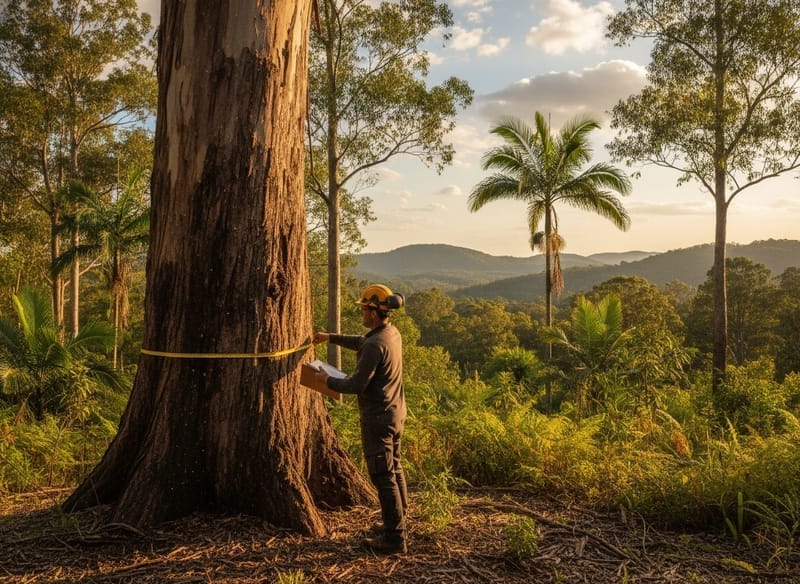
Our consulting arborist attends the site to measure, photograph, and assess the trees.
We compile a detailed, legally defensible written report.
You receive a PDF copy ready for submission to the NSW Planning Portal or your certifier.
If you require a comprehensive Arborist Report Faulconbridge, our team of AQF Level 5 consulting arborists is ready to assist.
Property owners, builders, and developers across the mid-mountains know that managing established trees is a major part of living in our beautiful region. With mature Smooth-barked Apples and tall Sydney Peppermints often towering over roofs and fence lines, securing the right documentation is critical before any major tree removal or development project begins.
Whether you are planning an extension on a steep escarpment block, responding to a council request for a Development Application (DA), or dealing with a hazardous tree leaning dangerously close to your home, a professional assessment is your first step. We provide detailed, independent, and council-compliant reports that take the guesswork out of tree management. Our local knowledge of Faulconbridge means we understand exactly what Blue Mountains City Council requires, ensuring your project moves forward smoothly without costly delays.
A common mistake property owners make is submitting a basic letter from an unqualified tree lopper instead of a formal arboricultural assessment. Blue Mountains City Council will outright reject tree removal or development applications if the documentation does not meet their strict criteria. Without an AQF Level 5 consulting arborist, your application is highly likely to be knocked back, wasting your time and money.
Furthermore, failing to properly identify Tree Protection Zones (TPZ) and Structural Root Zones (SRZ) under AS4970 guidelines can lead to devastating consequences during construction. Excavators and builders might unknowingly sever critical roots, causing a massive Blue Mountains Ash or planted Radiata Pine to become structurally unstable. This not only puts your property at extreme risk of tree failure during winter westerlies, but can also result in massive council fines for illegal damage to protected vegetation.
Our solution is simple: we provide highly detailed, legally robust documentation. We conduct thorough Visual Tree Assessments (VTA) and map out exact retention strategies, hazard profiles, and ecological impacts. By choosing our qualified team, you receive a report that satisfies council planners, protects your property assets, and clearly outlines the safest, most compliant path forward for your trees.
We provide a complete range of consulting services to suit any residential, commercial, or municipal requirement in the Blue Mountains.
Detailed arboricultural impact assessments required by council when building near protected trees. Includes species ID, DBH, Safe Useful Life Expectancy (SULE), and retention recommendations.
Comprehensive strategies to protect retained trees during construction. We map out Tree Protection Zones (TPZ) and Structural Root Zones (SRZ), specifying fencing, root mapping, and supervised work zones.
Formal Visual Tree Assessments (VTA) evaluating defects, structural integrity, and target zones. Crucial for pre-purchase inspections, schools, strata management, or addressing neighbour disputes over dangerous trees.
Required when applying for an Approval to Manage Trees permit under Part C5 of the Blue Mountains DCP. Documents tree health, disease, and structural risk to justify removal and suggest replanting options.
Professional defect analysis, causation reporting, and expert witness documentation for property damage claims caused by fallen limbs or uprooted trees during severe mid-mountains storms.
Getting your Arborist Report Faulconbridge completed is a straightforward process when you work with our local team. Here is how we manage your consulting project from start to finish.
Every report we produce is written and signed off by an AQF Level 5 Diploma-qualified consulting arborist, which is the mandatory standard for local council submissions. Our consulting practices strictly align with AS4970 Protection of Trees on Development Sites and AS4373 Pruning of Amenity Trees, ensuring all recommendations meet Australian legal and industry benchmarks.
We are fully public liability and professional indemnity insured, giving you absolute peace of mind when we step onto your property. From assessing a hazardous eucalypt to mapping out a complex DA site, our team operates with uncompromising professionalism, safety, and technical accuracy.
Faulconbridge presents unique arboricultural challenges. Almost every home sits in a bushfire-prone area, surrounded by cool to warm temperate eucalypts like Red Bloodwoods and Smooth-barked Apples. Under Part C5 Tree and Vegetation Preservation of the Blue Mountains Development Control Plan 2015, you need a permit for any tree over 4 metres tall or with a canopy spread wider than 4 metres.
While the 10/50 Vegetation Clearing Code allows some clearing near habitable buildings, entitlements must be verified parcel by parcel, and steep blocks over 18 degrees slope may even require a geotechnical assessment alongside your tree documentation. Our team understands these hyper-local overlays perfectly. We know exactly how to assess landslide risks on escarpment properties, map out Asset Protection Zones (APZ) correctly, and write reports that navigate the specific environmental sensitivities of the mid-mountains, saving you from prolonged council disputes.
Once your report is finalized and submitted, the next steps depend on the local council's determination. If your development application or removal permit is approved, our AQF Level 3 climbing arborists are ready to execute the practical tree work, fully compliant with the report's specifications. For retained trees, you will need to install the specified protective fencing and root barriers before any earthworks begin. We recommend booking us for periodic site inspections during your build to ensure all AS4970 tree protection measures remain intact. If you notice sudden canopy dieback or fungal growth on a retained tree after a severe storm, contact us for a reassessment.
Report pricing depends on the number of trees and the complexity of the development.
We provide a fixed-price proposal before undertaking any consulting work.
Consulting services available region-wide.